|
Tales of Stream Monitoring Fun
|

|
|
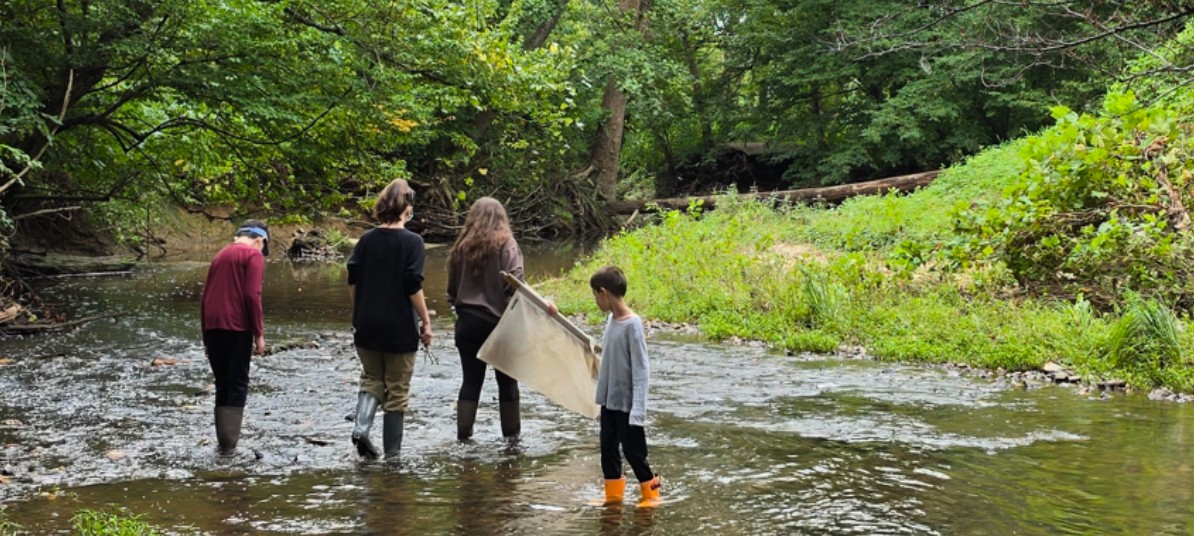
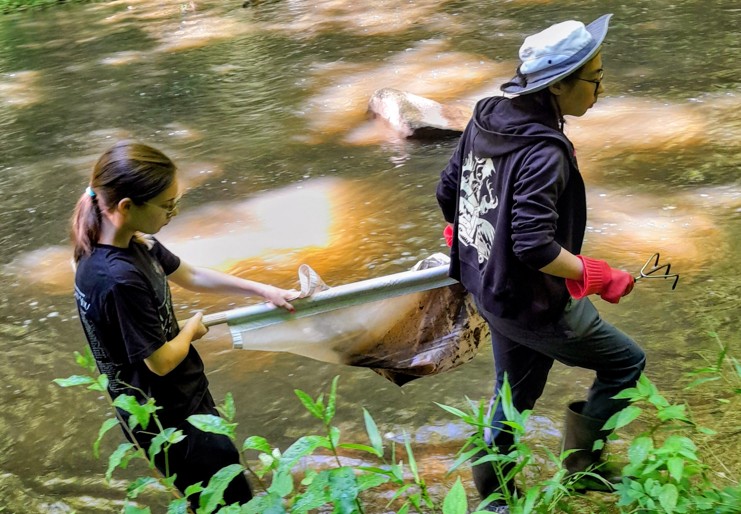
Friends of Accotink Creek and Friends of Lake Accotink Park hold biological stream monitoring workdays four times per year. |
|
|
September 12, 2026 Stream Monitoring: Following new seasonal protocols determined by the monitoring sponsoring organization, Virginia Save our Streams, we will no longer be monitoring in all four seasons, but only spring and fall. To continue our tradition of four monitoring sessions per year, we decided to revive a monitoring site in Wakefield Park. At one time, this site had been monitored by Northern Virginia Soil & Water Conservation District , but has been inactive for a decade. This added location will provide comparisons of conditions both upstream and downstream from Lake Accotink. It was a good day for monitoring, with lightly overcast skies and temperatures in the low 70's. We had a group of 9 volunteers. Our catch today was a remarkable contrast with what we have come to expect at our downstream site, with large numbers of beetles and mayflies helping to boost our score. Today Accotink Creek earned a stream health score of 9, meeting the acceptable threshold on the 0 - 12 scale. The highest previous score at this site from 2012 to 2015 was only a 6. See the tabulated results here and on Clean Water Hub |
|
|
It was a good day for monitoring, with partly overcast skies and temperatures rising into the upper 70's. Rain the previous day made the water a little high for optimum monitoring, but the water was just low enough, and continued falling appreciably while we worked.. For the past four June sessions, we have needed only one net to collect the required minimum of 200 invertebrates. We were not so fortunate today, with three nets required. Our catch today was dominated by Netspinner caddisflies and aquatic worms, species tolerant of impaired water. We seldom se a gilled snail here, so it was a welcome surprise ro find one today. Not so welcome was our high catch of lunged snails, so tolerant of impaired water that they bring the score down. Accotink Creek achieved a stream health score of 3 on the scale of 0 to 12, where 9 is the minimum score in the acceptable range. | |
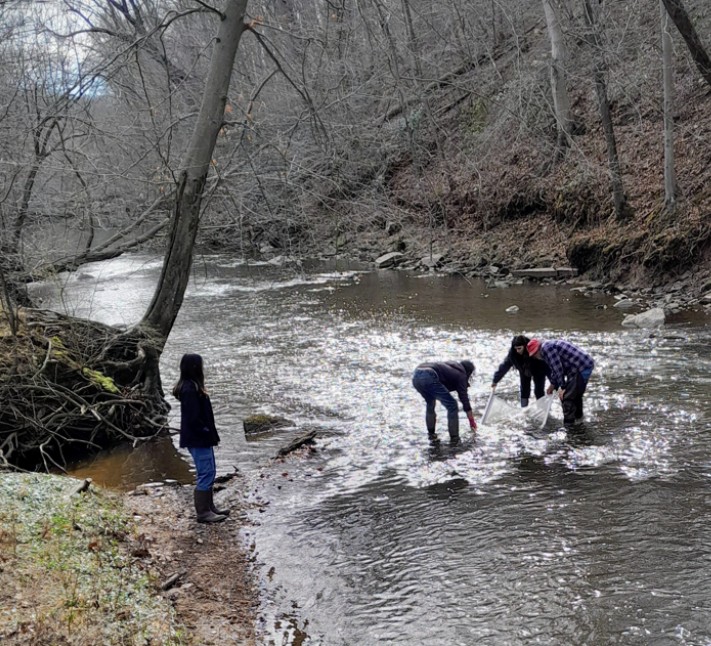 Late winter monitoring on a muddy Accotink Creek |
March 14, 2026 Stream Monitoring:

We had a crew of 6 volunteers today. The weather was favorable, mostly sunny and cool. Water levels were at about the maximum for practical sampling, due to continuing runoff from rain and snow two days ago and even melting of snow piles left from a heavy January snowfall. We set the maximum of 4 nets, but collected only 103 invertebrates, less than the minimum of 200 required for a statistically valid sample. Although not statistically valid, Accotink Creek received a poor numeric stream health score of 6 on a scale of 0 to twelve, typical of the range of scores over the years at this site. See the tabulated results here and on Clean Water Hub Chloride from road salt is known to be detrimental to aquatic life. There is no direct proof of cause and effect on our results, but the exceptional levels of road salt application during and after the January snowfall may have caused enough mortality to explain our low catch of invertebrates today. 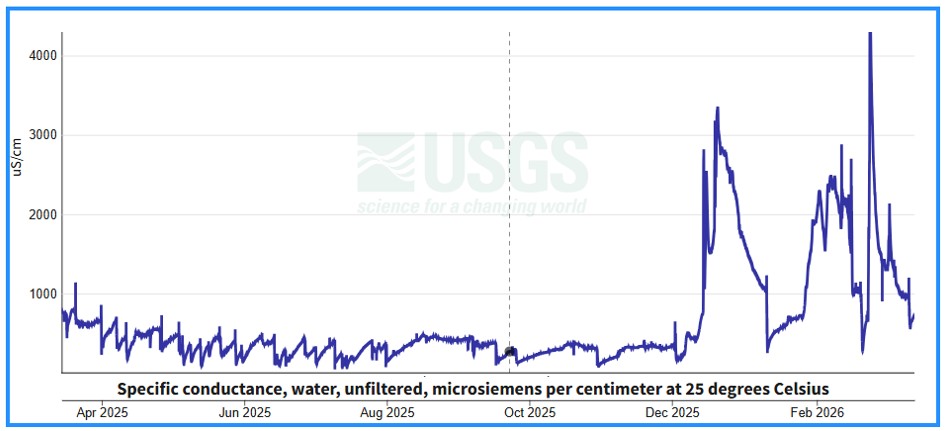
Appalling spikes in Accotink Creek water salinity this winter
Paved surfaces are the nemesis of Accotink Creek's benthic invertebrate population. All the runoff during rainstorms pours down storm drains and shoots into the creek, scouring away the banks and smothering stream life in fine sediment. Take advantage of financial incentives to become part of the solution with Conservation Assistance.
|

|
Accotink Creek Creatures
A lament for aquatic invertebrates penned
GET YOUR BRAIN WET!
Plan now to volunteer again with others to preserve our oceans and waterways Back to our main Monitoring Page
|